
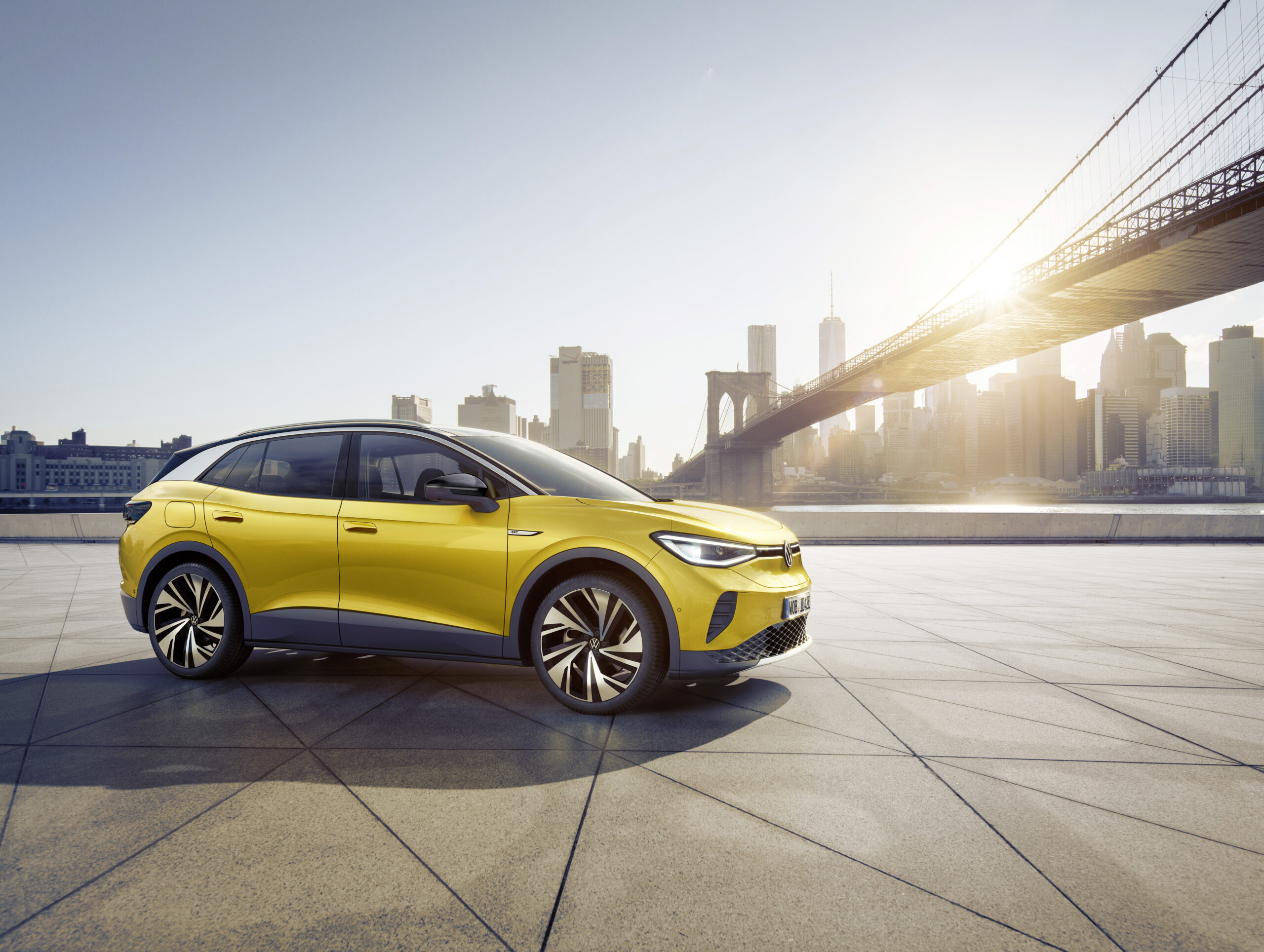
The Volkswagen ID.4 is more than an electric SUV with a familiar badge.
It is Volkswagen’s mainstream EV package for daily range, charging habits, cabin tech, and driver-assistance features.
That makes its technology story more useful than a spec-sheet comparison.
The real question is how its platform, software, charging setup, and safety systems work together in everyday ownership.
Why the ID.4’s EV Platform Matters
The ID.4 is built around Volkswagen’s dedicated electric-vehicle approach, so its layout differs from a gasoline SUV converted to battery power. The battery sits low in the vehicle, the cabin is shaped around electric packaging, and the driving experience centers on smooth power delivery rather than gear changes.
For shoppers, that matters in practical ways. The cabin can feel open because the platform does not need the same mechanical tunnel layout as a traditional combustion vehicle. The low-mounted battery helps the SUV feel planted. The vehicle’s technology choices are also tied closely to battery management, charging behavior, software controls, and driver-assistance systems.
The useful way to read the ID.4 is as a connected EV platform, not just a vehicle with an electric motor.
Charging Depends on Conditions, Not One Peak Number
Charging an ID.4 depends on more than the number printed on a charging-station sign. Model year, battery state, battery temperature, charging equipment, station reliability, and software behavior can all affect a session.
That is why a practical ID.4 charging plan starts with the owner’s routine. Home charging is usually the most predictable part of EV ownership because it turns daily driving into an overnight habit. Public fast charging matters most for road trips, busy weeks, and drivers who cannot charge at home.
The takeaway is simple: do not judge the ID.4 by one charging figure. Look at where you will charge, how often you drive, and whether your common routes have dependable stations.
Plug&Charge Can Reduce Friction When the Setup Matches
Plug&Charge is one of the features that can make an EV feel more like a finished consumer technology product. In compatible situations, the driver connects the charging cable and lets the vehicle, account, and charger handle authentication.
That convenience depends on the vehicle, account setup, software state, charging network, and station compatibility. It should not be treated as a universal guarantee across every ID.4, every owner account, or every public charger.
For a buyer or owner, the practical move is to check how the exact vehicle supports payment, account activation, and charging-network access before relying on Plug&Charge for a long trip.
The Charging Ecosystem Shapes Ownership
An EV’s technology does not stop at the vehicle. The charger, app, payment account, route plan, and support process all become part of the daily experience.
That is especially important for families and first-time EV owners. A gasoline vehicle can usually be refueled quickly almost anywhere. An EV asks the owner to think more carefully about home charging, destination charging, public fast charging, and backup options.
The ID.4 can fit well when the owner has a clear charging routine. It can feel less convenient when public charging is the only plan and local stations are inconsistent.
Cabin Software Shapes the First Impression
Inside the ID.4, software is not a side feature. It affects climate controls, navigation behavior, media use, charging settings, vehicle information, and the overall feel of the cabin.
That can be a strength when the interface feels familiar and the owner learns the menus. It can also create friction if a driver expects every common control to behave like a traditional button.
A good test drive should include more than acceleration and ride comfort. Spend time with the screen, steering-wheel controls, climate settings, phone pairing, navigation, charging menus, and driver-assistance displays. Those are the features owners interact with every week.
Connected Services Add Convenience, With Limits
Connected services can make the ID.4 easier to live with. Depending on vehicle configuration, model year, account status, and service availability, owners may use connected features for vehicle status, remote functions, charging information, or related ownership tasks.
The important word is depending. Connected-service behavior can vary by vehicle, region, software version, subscription status, and owner setup.
For used ID.4 shoppers, this matters even more. Confirm that the account can be transferred or activated, the vehicle’s software state is understood, and the features you expect are available on that exact vehicle.
Safety Tech Is Assistance, Not Autonomy
The ID.4’s safety and driver-assistance story should be read carefully. Modern driver-assistance systems can help with awareness, lane support, speed assistance, parking situations, and collision-risk warnings, depending on equipment and conditions.
They do not turn the vehicle into a self-driving car.
That distinction matters because the best safety technology still depends on driver attention, road conditions, weather, markings, traffic behavior, and system limits. The useful question is not only whether the car has a feature name. It is how the feature behaves in the situations you actually drive through.
On a test drive, pay attention to alerts, steering-assistance behavior, visibility, camera views, parking support, and how clearly the vehicle communicates what its systems are doing.
Recall Checks Belong in the Tech Review
Software, electronics, charging systems, and safety systems make modern vehicles more capable, but they also make official recall checks more important.
NHTSA campaign 26V030 is part of the official recall context for this topic. That does not mean every ID.4 is affected in the same way, and it does not replace a VIN-specific lookup.
For any ID.4 purchase, lease, or service decision, check the exact vehicle through official recall tools and dealer service records. That is not just paperwork. It is part of evaluating a connected vehicle whose technology stack may depend on software updates, service actions, and hardware status.
Production Context Helps, But It Should Not Decide the Purchase
Volkswagen Group reporting gives broader business and production context around the company’s electric-vehicle activity. That context is useful for understanding where the ID.4 fits inside Volkswagen’s EV strategy.
It should not be stretched into a claim about every market, every dealer, or every future retail decision.
For readers, the better approach is practical: treat production and business context as background, then evaluate the exact ID.4 in front of you by model year, trim, battery condition, software state, charging needs, warranty status, service history, and recall status.
Who the ID.4 Makes Sense For
The ID.4 is most compelling for drivers who want an electric SUV with a mainstream cabin, practical daily usability, and technology that supports routine commuting rather than chasing the most extreme EV spec.
It is a better fit when home charging is available, the owner is comfortable using vehicle software, and common routes have dependable public charging backup.
It is a weaker fit when the driver needs frequent long-distance fast charging without planning, dislikes screen-centered controls, or cannot confirm the exact vehicle’s connected-service and recall status.
What to Check Before Buying or Leasing
Start with the exact model year and trim. ID.4 features, charging behavior, software details, and equipment can vary, so broad statements are less useful than vehicle-specific checks.
Review the charging plan. Know whether you will charge at home, at work, on public fast chargers, or through a mix of options.
Test the cabin software. Pair your phone, open the charging settings, adjust climate controls, try navigation, and inspect the driver-assistance displays.
Confirm connected-service access. Make sure the account setup, available features, and ownership transfer process match your expectations.
Run an official recall lookup. Use the exact VIN and review service records before treating any vehicle as ready to buy.
Related articles
Bottom Line
The Volkswagen ID.4’s technology story is strongest when viewed as a complete EV ownership system. The platform, charging setup, Plug&Charge support, cabin software, connected services, and driver-assistance features all shape the daily experience.
For the right driver, that can make the ID.4 feel like a practical and approachable electric SUV. For the wrong routine, the same technology can create friction.
The smart move is to evaluate the exact vehicle, the exact charging plan, and the exact software and service status before deciding.
FAQ
Is the Volkswagen ID.4 a good daily EV?
It can be a good daily EV when the owner has a predictable charging routine, understands the cabin software, and confirms the exact vehicle’s equipment and service status.
Does the ID.4 fast charge at the same speed every time?
No. Fast-charging behavior can depend on battery state, temperature, charger capability, station reliability, software, and the specific vehicle configuration.
Does Plug&Charge work on every ID.4 and every charger?
No. Plug&Charge depends on compatible vehicle support, account setup, charging-network support, station behavior, and software status.
Should used ID.4 buyers check recalls?
Yes. A VIN-specific official recall lookup and service-record review should be part of any used ID.4 buying process.
Are the ID.4's driver-assistance features self-driving?
No. Driver-assistance features support the driver in certain conditions, but they do not replace attention, judgment, or responsibility.