
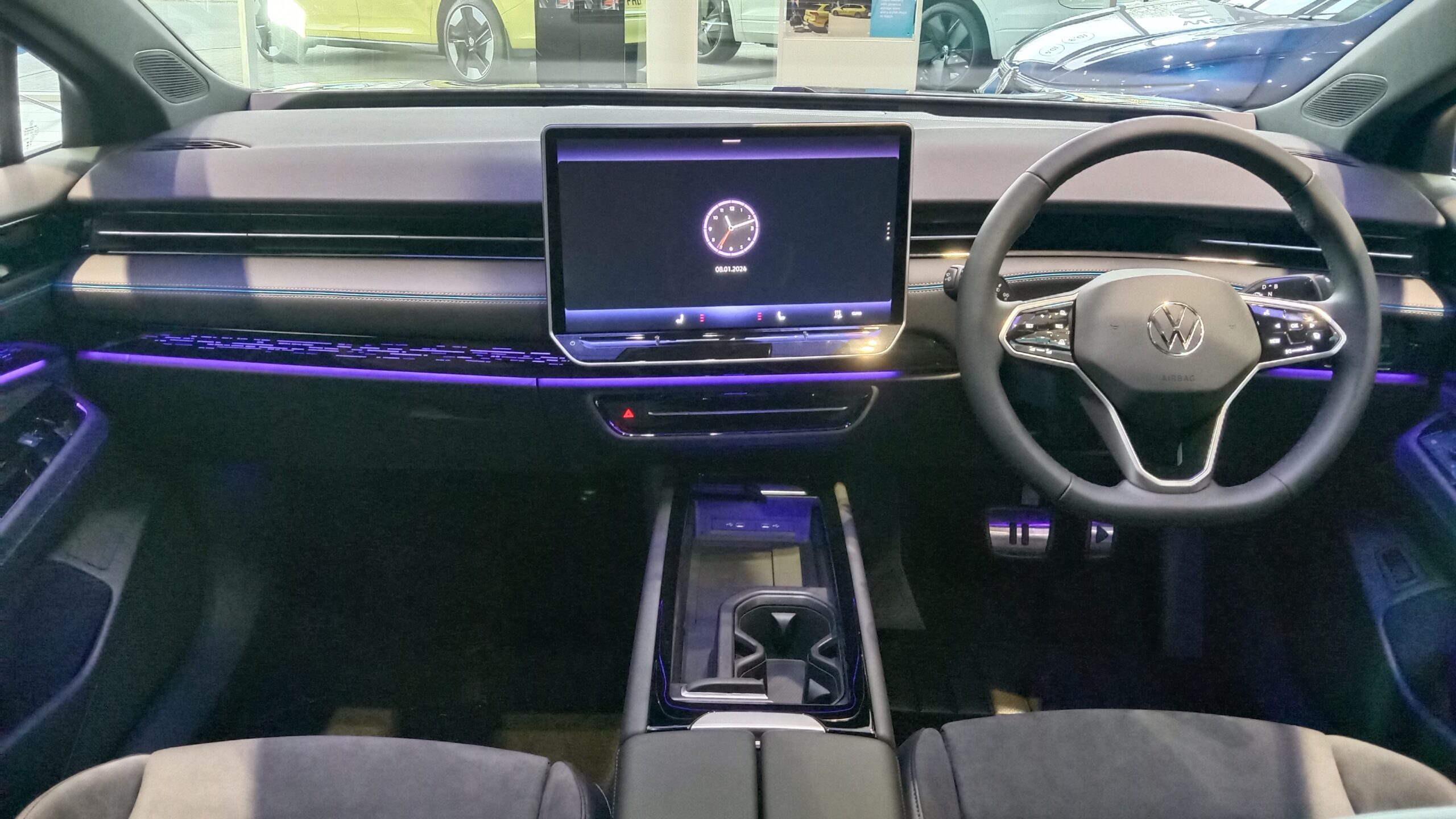
A car interface is not just a screen. It is the part of the car you deal with every day.
That is why the VW MIB4 driver interface matters.
Volkswagen presents its newer infotainment direction around faster responses, clearer controls and better voice help.
The real question is simple: does this approach make normal driving tasks easier, or just move the frustration around?
What the VW MIB4 driver interface means
The VW MIB4 driver interface is best understood as Volkswagen’s newer infotainment and cabin-control approach, not a promise that every model uses identical hardware, menus or features.
For shoppers and owners, the phrase usually points to the daily control layer: the central screen, climate access, shortcuts, navigation, media, phone projection, voice commands and the way the car reacts when you need something quickly.
Volkswagen’s own material around the ID.7 describes a new display and operating concept shaped by customer feedback. Its material for the updated Golf also points to next-generation infotainment, quicker processing and more intuitive operation.
Those are useful signals, but they should be read carefully. A better interface direction does not mean every Volkswagen cabin behaves the same way.
Why people are searching for it now
Drivers do not search for infotainment systems because they love software architecture. They search because the screen affects simple moments: changing temperature, finding a route, taking a call, changing audio or getting home without fighting the menu.
Volkswagen has also been under pressure because touch-heavy interiors can frustrate drivers when basic controls are buried or slow. Car and Driver has covered Volkswagen’s move back toward more physical controls, which gives this topic a clear update hook.
At the same time, Volkswagen has been adding smarter voice-assistant features. The Verge reported on VW’s IDA assistant and ChatGPT layer, which adds another question: can voice help reduce screen digging, or does it become one more feature to manage?
The core usability question is task speed
Large screens can look modern in photos, but the useful question is whether common tasks are easy to repeat.
A good driver interface should make these jobs feel obvious:
- adjust cabin temperature without hunting through menus
- switch audio sources without losing the map
- start navigation with minimal delay
- understand phone connection status
- use voice help for simple requests
- find key shortcuts after the first few drives
The VW MIB4-era approach appears to move Volkswagen in a better direction because the brand is emphasizing faster processing, clearer operation and customer feedback. The payoff depends on the exact model, trim, market and software version.
That is why shoppers should treat the interface as something to inspect in the actual vehicle, not as a universal spec-sheet win.
Where the newer approach looks stronger
The strongest part of Volkswagen’s reboot is the acknowledgement that interface friction matters.
The ID.7 is the clearest example in the current source set. Volkswagen presents it with a new cockpit direction, and WIRED’s ID.7 review gives independent product-experience context around the car’s cabin and technology. The important takeaway is not that every Volkswagen now feels like an ID.7. It is that the ID.7 shows where VW wants its interface experience to go.
The updated Golf matters for a different reason. It connects the same broader conversation to a familiar VW nameplate, which makes the interface reboot more relevant to mainstream shoppers.
The move toward better physical controls is also meaningful. Touchscreens can be useful, but drivers still benefit when high-frequency actions have a predictable place.
Where drivers should stay cautious
The main risk is assuming that the MIB4 label answers every usability question.
It does not.
A buyer still needs to check the exact car. Screen layout, voice-assistant scope, phone projection behavior, steering-wheel controls, climate access and shortcut placement can vary by vehicle and equipment.
Voice assistance is another area where expectations should stay grounded. A smarter assistant can reduce taps for some requests, but it should not be treated as a replacement for clear on-screen controls. It also should not be assumed to control every core vehicle function.
The practical verdict is cautious but positive: Volkswagen’s newer direction looks more aware of real driver pain points, but the experience still has to prove itself in the exact cabin you are considering.
Practical examples to try on a test drive
A useful way to judge the VW MIB4 driver interface is to run the same quick routine you would use in normal life.
Start with climate. Can you change temperature, fan speed or seat comfort settings without stopping your conversation or staring too long at the screen?
Then try navigation. Search for a destination, start guidance and return to the home screen. Notice whether the car responds quickly and whether the route remains easy to read.
Next, connect your phone. Check whether the interface makes the connection state clear. If you use CarPlay or Android Auto often, make sure switching between phone projection and native VW functions feels natural.
Finally, try voice help for a simple request. The goal is not to stress-test every command. It is to see whether voice assistance saves taps for everyday tasks.
If one of those steps feels confusing in a quiet showroom, it may feel worse during a busy commute.
Common misconceptions about VW’s rebooted interface
The first misconception is that a newer screen automatically means a better interface. Speed, layout and control placement matter more than visual size alone.
The second is that one model proves the whole lineup. The ID.7 and Golf are useful examples, but they do not make every Volkswagen implementation identical.
The third is that voice AI fixes a cluttered interface. Voice help can be useful, but it works best when the screen and physical controls are already understandable.
The fourth is that physical controls and touchscreens are enemies. The better approach is usually a smart mix: screen depth for complex tasks, direct controls for frequent actions.
Verdict: does Volkswagen’s rebooted approach work?
As a direction, yes. Volkswagen appears to be moving toward a more usable balance of faster infotainment, clearer control logic, voice assistance and renewed attention to physical inputs.
As a blanket buying conclusion, no. The VW MIB4 driver interface should be judged in the exact vehicle, with the exact features and controls a driver will use every week.
The best sign is not whether the cabin looks futuristic. It is whether the car lets you complete normal tasks without thinking about the interface at all.
Read more
- Volkswagen Infotainment Not Working: Reasons And Fixes
- BMW iDrive vs. CarPlay vs. Android Auto
- Nissan Connect Infotainment System: How User-Friendly Is It?
- BMW iDrive 9 Review: The Knob Gets A Send-Off From Android Automotive
FAQ
Is the VW MIB4 driver interface the same in every Volkswagen?
No. It is safer to treat it as a newer VW infotainment direction, then check the exact model, trim and market.
Does Volkswagen's newer interface bring back physical buttons?
Volkswagen has signaled a move back toward more physical controls, but availability and layout should be checked on the specific vehicle.
Is ChatGPT part of the VW MIB4 experience?
Volkswagen has added a ChatGPT layer through its IDA voice-assistant experience in supported vehicles and markets. It should be treated as voice-assistant help, not a universal control system.
What should I try first in a VW showroom?
Try climate control, navigation, phone projection, media switching and one simple voice command. Those tasks reveal more than the screen size.
Is the VW MIB4 driver interface worth caring about?
Yes, because it affects everyday driving comfort. A car can be mechanically good and still feel irritating if basic controls are slow or buried.